
Lessons in gender
How kids were taught that dismantling sex was moral, proper and clever
An intoxicating idea
In New Zealand, around 2015, a bubbling trend really took off. Lots of New Zealand kids got the idea that the categorisation of humans into sexes wasn’t a description of material reality but something artificial that was imposed on them. Some of these kids decided that their own sex was like an outfit that didn’t suit them and they needed to change it. Their true self needed to be liberated from the earthly packaging of their sexed body. If they could just shuck off their mortal wrappings, their biological destiny, the name and the pronouns given to them by their parents, then they could be truly free. In doing so they would be part of a radical new human rights movement, more open and tolerant and insightful than any generation before them.
We see the phenomenon in the statistics. In the 2021/2022 Growing up in New Zealand study, 8.2% of girls and 1.5% of boys reported non-binary or transgender identification. New Zealand prescriptions for puberty blockers for 12-17 year olds rose slowly from 2008 and then rapidly from 2016 until 20211. Blocking puberty is no minor intervention. When used for gender dysphoria, puberty blockers disrupt the healthy endocrine systems of our rangatahi. They stop the release of hormones associated with physical, emotional and cognitive development. Parents and kids have been told they are lifesaving, reversible and safe but there’s no evidence for that.
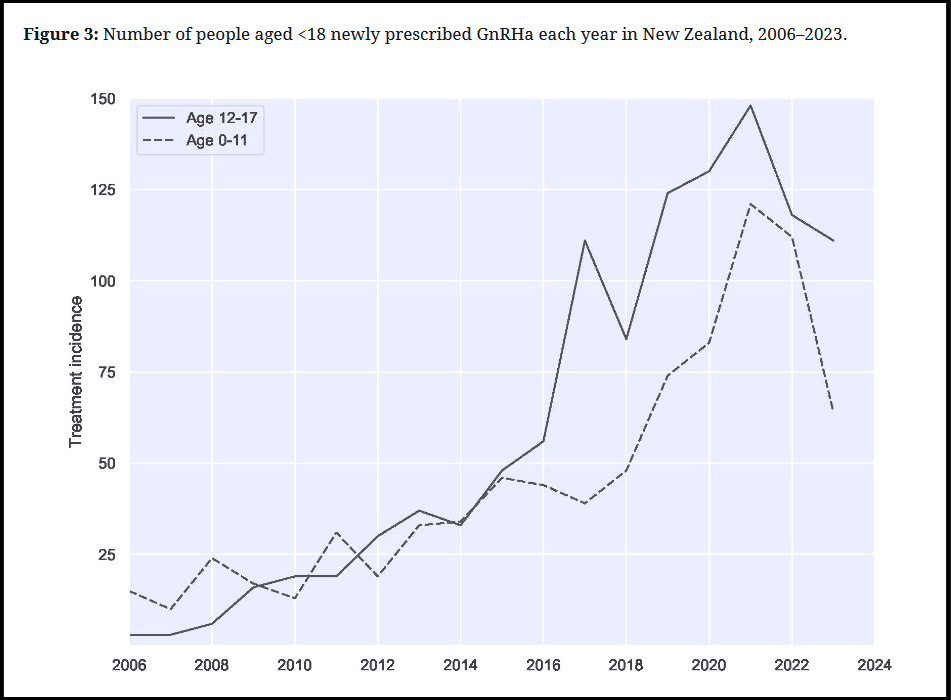
By 2020, the cumulative rate of NZ puberty blocker prescription for the previous 14 years was 6.9 times that of Wales and England2. Following scandal associated with the UK’s sole gender clinic, and a four year in-depth enquiry into the treatment of gender dysphoria which found no good evidence that blockers were safe or improved mental health, the UK joined many countries and banned the medication. In New Zealand, where a far larger proportion of our young people are affected, a 2025 government move to ban new prescriptions is being undermined through a High Court injunction.
Why are kids denying sex?
Sex, in case you haven’t picked this up, evolved a billion years ago. The two sex model is the reproductive strategy used by humans and every other species of mammal: roughly one half of the population goes down a development pathway where their bodies are organised around producing sperm, and the other half down a development pathway where their bodies are organised around producing eggs. There are no politics or belief systems involved in this, it’s just how it works. There are thousands of physical differences between males and females, beyond the obvious genital ones. People can take drugs and have surgeries that may make them more closely resemble another sex or less like their own sex. This may alleviate distress for some people, but their sex has not changed. Very rarely, something goes wrong with the developmental pathway, but this does not mean sex is not real. Denying the fact that there are two immutable sexes denies the science and reality of reproduction and evolution.
So how did kids get such a basic idea all wrong? Was there some cranky religious force in play persuading kids to adopt faith-based explanations for how the world works? Perhaps it was some creationists who believe fossils are sent to test us and sex was invented by God a few thousands years ago? Perhaps it was a new kind of spiritualist promoting the idea of an inner pure gender soul at odds with our sinful sexy flesh? Or maybe it was prim, puritanical people who can’t stand the bold facts of our bodies, of how new humans are made, and of how awkward, awful or pleasurable that process can sometimes be?
Could crackpots have infiltrated our secular public school system? Could such beliefs have come into schools disguised in some innocuous cloak? Could they have been ushered in through misguided good intentions? Well, yeah, kind of, all of this.
School resources
Over the last decade successive governments have funded third party production of school resources aimed at reducing bullying of rainbow-identified kids, increasing inclusion and supporting the gender and sexuality aspects of the Relationship and Sexuality Education (RSE) curriculum. That all sounds great.
There would be no problem, of course, in resources or teaching that explains to young people that transgender or non-binary identified people, alongside gay people and everyone else, should not be bullied. Schools should also reinforce that no one should be sexually or otherwise harassed. It is also fine to mention that transgender-identified people often describe their experience as feeling like their biological sex is incongruent with their inner sense of gender. Tolerance for different faiths and world views could be taught alongside facts about and with a focus on biological sex, puberty and sexuality. This type of compassionate, reasoned teaching is not what’s been going on.
Since 2015, coinciding with that rapid rise in puberty blocker prescription and the increase in non-binary and trans identification, school resources have been teaching kids gender ideology. That’s the suite of beliefs that says everyone has a gender identity, gender identity is more important than biological sex, gender identity and sex exist on a continuum, defending sex-based rights is bigoted, and women can have penises. Gender ideology is not taught as a set of beliefs, it’s taught as fact.
These beautifully produced, engaging school resources are part of a much wider ecosystem of websites, posters, organisations, campaigns, pamphlets, comics, guides and media that promote gender ideology. This ecosystem includes material produced by community groups, unions, large charities, media, government departments (though some of this is calming down) and public health sites. They all reference each other building the false idea that there is a consensus around gender ideology.
The key messages
I’ve been looking at school-specific resources and I think there are four particular messages that help explain why kids have become so confused about sex. These messages reinforce each other. They’re morality lessons really, where not only the substance of the faith is taught, but the importance of being faithful. Many adults have fallen for these ideas. For young people, in formal education settings, desperate for ideas that help them work out what kind of adult they want to be, often beautifully idealistic, almost all feeling awkward in their changing bodies, the ideas must be nearly impossible to resist.
Message 1: Gender identity is universal.
Kids are told that while sex is what is between your legs, gender is what is in your heart and head. Gender identity is an inner feeling about your physical sex that is more true and more important than physical sex. It is something that everyone has and young people need to work out. Gender identity is both an essential part of someone and can change over a life time. Gender identity might or might not align with biological sex.
There’s an element of fun to figuring out your gender identity. It feels like a small leap from declaring your favourite Pokémon character, or taking an online quiz for which Hogwarts house you’d be in, or knowing which star sign you’re meant to be compatible with.
Message 2: Sex is on a spectrum, changeable and complex
Often resources will present confusing and contradictory information. They will announce that sex and gender are separate things and then conflate the two things. Biological sex, when discussed at all, is framed, like gender identity, as existing on a continuum and as changeable. It is described as a highly complex, layered combination of factors like chromosomes, hormones and body parts. The easy-to-grasp, straightforward association between sex and reproductive roles is scarcely mentioned. If it is mentioned, it is overlayed with discussions of gender and continuums. The extremely rare occurrence of differences of sex development (DSDs) are given undue attention. They are labelled ‘intersex’ conditions. a label rejected by most medical practitioners and many of those who have the condition as it is misleading. DSDs are used by ideologues to suggest that categorisation of human sex into male and female is wrong. Labelling humans by biological sex is often promoted as limiting and restricted.
Message 3: The only way to reject sex stereotypes is to reject sex
The third message is that the only way to reject regressive sex stereotypes is to reject one’s sex. Those designing the messaging in these resources seem to be under the impression we are living in the 1950s. A society that enforces old-school forms of debilitating sexist stereotypes suits the narrative. It creates a problem where girls and boys are forced into extremely narrow gender roles and then offers gender ideology as the solution. Society is not the problem, biological sex is.
If you’re a girl who wants to be a CEO, don’t want to wear pink and want to play with the boys, it’s not entirely reasonable, it’s because your gender identity is not aligned with your sex! If you’re a boy uncomfortable with masculinity or male stereotypes, you might not be a real boy! Luckily, the resources say, if you don’t like social expectations around your sex, you can go and talk to Rainbow Youth.
Of course such messaging does nothing for breaking down binary social expectations for each sex, it reinforces them. It reasserts the idea that proper boys and girls behave in particular ways. It rejects feminism and other social movements which seek to transform society and promotes instead the transformation of one’s self.
Message 4: Rejecting sex is moral, intelligent and kind
The fourth message is that accepting gender ideology is the only moral way to behave. You can, according to these resources, be a good, kind, tolerant and intelligent person or you can stay on the dark, unenlightened side and continue your cruel belief in two sexes. The only way to support trans and non-binary people is to accept their identity as real and accept gender ideology into your heart.
“Critical thinking is the foundation for open minds and hearts” says the Inside Out website (see below) on the page aimed at teachers. “This resource uses a norm-challenging approach to explore homophobic and transphobic discrimination from another angle—to deconstruct the norms that construct homophobic and transphobic attitudes.” The norm that it appears to want to deconstruct is kid’s gut instincts about who is what sex and the science that backs those instincts up.
Three illustrative examples
These messages are everywhere, just google gender NZ to find local examples. Below, to illustrate what’s going on in schools in particular, I’ve mapped quotes from three key resources used over the last decade that show how the four messages may have wormed their way into our kids’ consciousness.
Inside Out—We All Belong
In 2015, Rainbow Youth in partnership with Auckland University, CORE Education and Curative produced the video series Inside Out—We All Belong3. It was funded by the Ministry of Social Development. Five videos were aimed at secondary students, and an introductory video focused on gender identity was aimed at year seven and eight students. The videos are colourful and feature various first hand accounts from people discussing their experiences around sexuality and gender identity.
The Real Sex Talk-Gender Identity
The Real Sex Talk—Gender Identity, part of a wider 2018 series on sex and gender topics, uses a similar talking heads format. Promoted by the Family Planning Association (FPA now Sexual Wellbeing Aotearoa)4, the Real Sex Talk credits Villainesse (who produced the video), Wireless, Rainbow Youth, Rape Prevention Education, FPA and NZ On Air.
Example Workbook
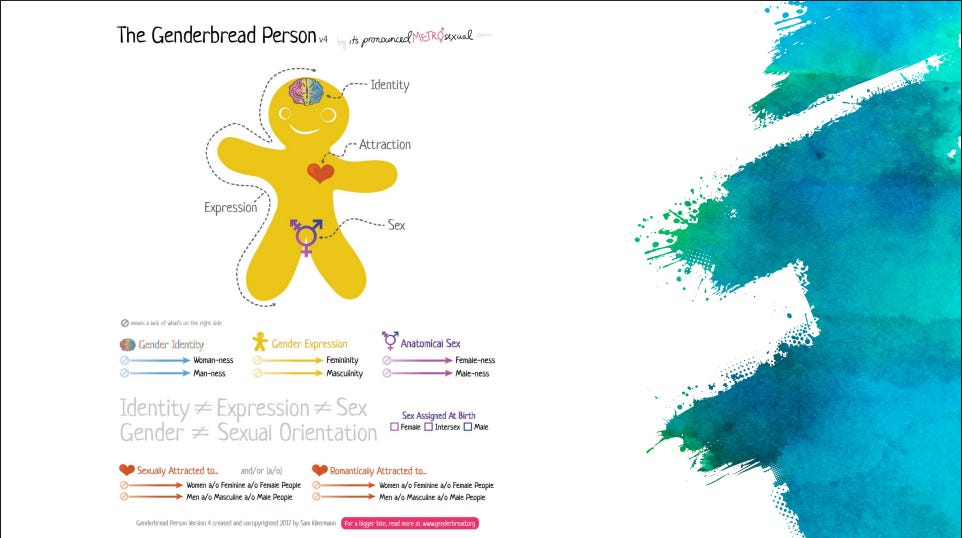
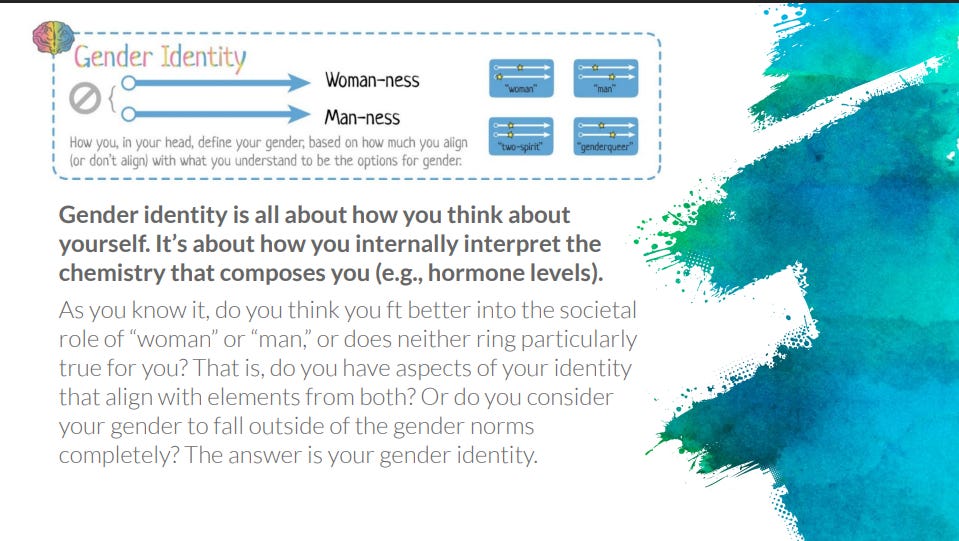
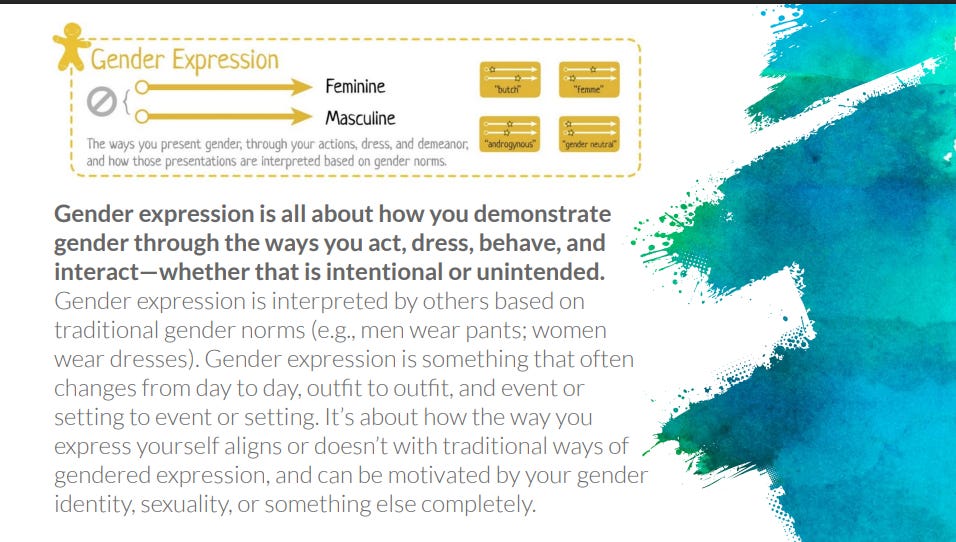
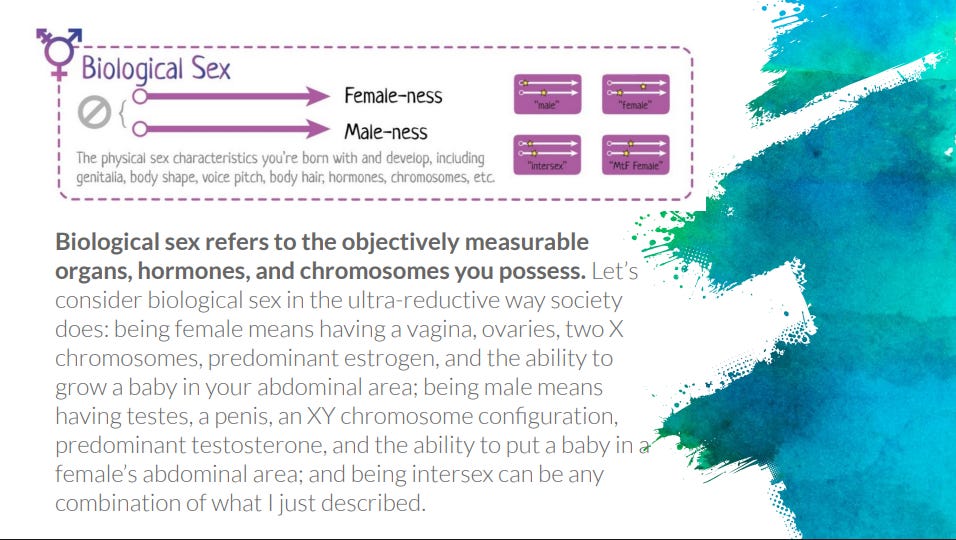
Example Workbook, Unit 4 Sexuality5 was sent in 2022 to a parent of a Year 9 student at a state secondary school asking what their child was being taught in RSE. Lessons 1-5 of the Workbook are fine. Those chapters contain good straightforward information. Lesson 6 on Gender and Sexuality, however, contradicts the previous lessons (which are clear about the differences between males and females). Lesson 6 uses the infamous and infantile Genderbread Person (screenshots below)6, which describes sex, sexuality, gender identity and gender expression as all belonging on a continuum. The Example Workbook also links students to the Real Sex Talk-Gender Identity video. I have not been able to source the origin of this resource, the document is called Example Workbook indicating it may be a guide used more widely than at a single school.7
Direct quotes from resources created for NZ school students
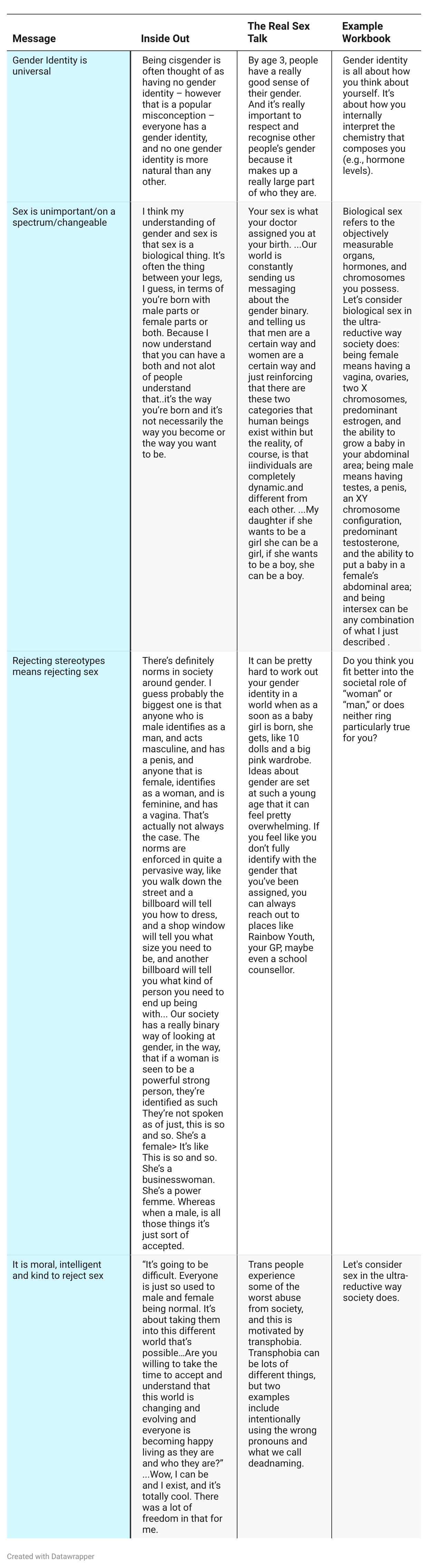
Screenshots from the Lesson 6 of the Example Workbook, Unit 4 Sexuality
Some of the information is visual and not able to fit into the table but is still worth sharing. Here’s the Genderbread person from the Example Workbook.
What’s the current status of RSE and related resources?
The RSE guidance around gender identity (gender ideology-based) was removed from the Ministry of Education website in March 2025. In April a draft framework for RSE was opened for public consultation and the new RSE curriculum was released in November. Resist Gender Education, a NZ group that advocates for science-based, age appropriate RSE in schools, is more or less pleased with the changes which removes mention of gender identity altogether. The group is rightfully disappointed that clarification about female and male bodies and gamete-based definitions of sex disappeared between the draft and final framework of the curriculum. Resist Gender Education also notes several worrying instances where sex-based experiences are reframed in sex-neutral terms so that, for example, neither menstruation or sperm production is associated with a particular sex.
The official NZ curriculum site has removed most resources relating to the old RSE curriculum. The two video-based resources I quote from are, however, still available online.
Te Kete Ipurangi (TKI), an education portal managed by the Ministry of Education is in the process of being closed down. It is unclear what is going to be migrated to the new site. TKI has an Inclusive Education8 subsite aimed at teachers. Its guide for LGBQTIA+ students still links to Rainbow Youth’s Inside Out videos. It may be that, as an anti-bullying resource, rather than explicitly as a RSE resource, gender ideology messaging has a workaround not subject to the same scrutiny as curriculum-linked resources.
Out left leaning parties were once the biggest advocates for keeping religion and education separate. Sadly, in the case of gender, that no longer stands. Unless Labour can be persuaded, the stay on teaching kids gender ideology may only last until the next election.
Various groups are, inevitably, crying foul at the removal of gender ideology from the curriculum. Their arguments are typically invidious. They try to link those who, like me, are passionate advocates of fact-based RSE, with those who would remove RSE altogether.
Paul, Charlotte, Simon Tegg, and Sarah Donovan. ‘Use of Puberty-Blocking Hormones for Gender Dysphoria in New Zealand: Descriptive Analysis and International Comparisons’. New Zealand Medical Journal 137, no. 1603 (2024): 79–88. https://doi.org/10.26635/6965.6587.
Paul et al. NZMJ, 2024.
Confusingly Inside Out, this video resource is different to InsideOUT the group.
FPA (now Sexual Wellbeing Aotearoa), was, for years, producing high quality sex education resources as well as advocating for good sex education, arguing it was empowering and important. It recognised the particular importance to girls and women of having control of their sexual and reproductive choices and the wider social benefits of this. Their resources challenged stereotypes and homophobia. Sex Matters Aotearoa’s health services are really important and it’s a great tragedy that it has adopted gender ideology. Another of my Substacks might focus on the organisation’s fall from grace. From being a progressive champion of clarity about bodies, puberty and sex, it now obscures and confuses. Visit the Sexual Wellbeing Aotearoa website to see the miracle of talking about periods, pregnancy, condoms and sex without mentioning, you guessed it, sex. The Wayback Machine, which archives the internet, can show before and after versions of FPA posters of male and female sexual anatomy. The before has clear sex-based labelling, then, in the makeover, the labels are gone. Sexual anatomy is unanchored. The penis and vagina are floating free not associated with any particular kind of person, unburdened by old-fangled things like accurate scientific labelling. All this is of course not good health information. It is not inclusive but ridiculous. Far better to have targeted resources for trans-identified people than abandon the principles of good, empowering and clear information for young people.
I can send the PDF of this resource on request.
Incidentally, a variation of the Genderbread Person, The Flying Gender Unicorn, is used in the NZ Police’s Rainbow 101 training. It’s interesting the energy put into this training, perhaps some basic Sexism 101 training would be better. Last year the Police Conduct Authority (PCA) found NZ police leadership had closed ranks to protect Deputy Police Commissioner Jevon McSkimming. Leaders ignored repeated complaints made against McSkimming by a former female colleague and instead charged the complainant with harmful digital communication. The PCA report led to several resignations. Later McSkimming was also convicted for possession of child abuse images.
If anyone can confirm the origin of the resource, I’d love to know.
The Inclusive Education subsite is itself, another example of the adoption of gender ideology being presented as the only moral course of action. First up in its list of actions to support LGBTQIA+, is building knowledge of sex, gender and sexuality diversity with links to a newspeak glossary. Sigh. Abandon all science, ye who enter here.
And another video promoted on the Inclusive Education site: Trans 101; here's a few tasty tidbits, that show that what I document in my essay is THE message, not a couple of outliers. Most of us are taught the idea that people are born a boy, or a girl and we're expected to act a certain way based on what's between our legs. But that actually isn't true for everyone. It totally ignores the huge and amazing world of people who're trans and gender diverse". COME ON, it totally ignores that stereotypes are stupid and you should ignore them and not take drugs. Also "When you're talking about gender and bodies, talk about what you actually mean, people who have uteruses, instead of women...." and "Learning this stuff, so you can be more informed is a pretty awesome thing to do". Sigh. Find the video on this page (https://inclusive.tki.org.nz/guides/supporting-lgbtqia-students/build-understanding-of-key-concepts-and-terms/) of the Ministry of Education Inclusive Education website
A perfect summary of the messages being given to our children, starting with three year olds. There are hundreds of picture books that tout these messages and the former RSE guide advised teaching 5 year olds that everyone has a gender identity. By the time sexual reproduction is taught at the age of 10-11, kids are so thoroughly indoctrinated that it is unsurprising to them that reproductive diagrams don’t have male or female labels (Navigating the Journey from SWA.)
You are correct that the curriculum is only part of the picture. NZ schools are still awash with transgender beliefs in library books, resources published by InsideOut and others, resources retained on the MOE website, and true believer teachers.